

By Benjamin Teisseire.
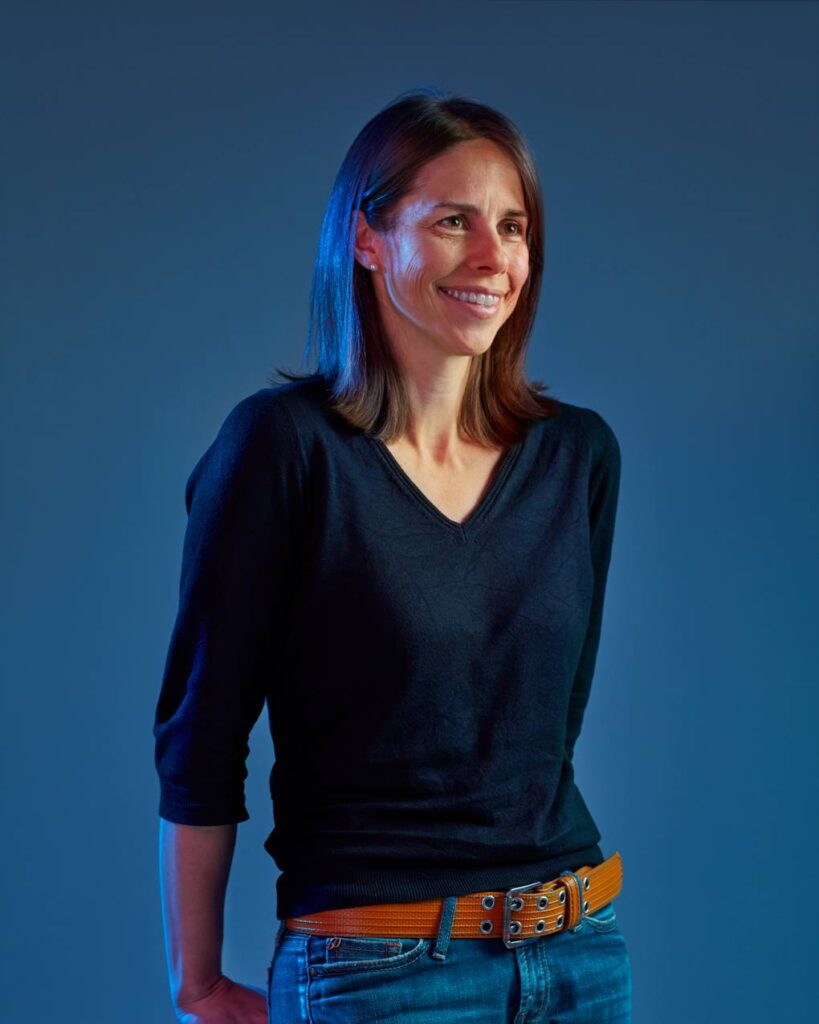
Elvis & Kresse is a UK-based luxury accessories manufacturer that uses only waste material as their raw material since its creation in 2005.
Twenty years in the making, they embody the true value of circularity principles and redefine luxury’s purpose towards, not only a net zero goal, but a regenerative one.
The Watch & Jewellery Initiative 2030 met with Kresse Wesling, co-founder of the company, to discuss circularity, creativity and transforming luxury’s business model.
What did you do before you started Elvis & Kresse? What pushed you to adopt a circular business model?
In the early 2000’s, I set up my first start-up, it was a biodegradable packaging company. I have been very eco-conscious from the very beginning. My first job was in a small venture capital firm in Hong-Kong. It was very interesting to see that there were many entrepreneurs with bright ideas and that the only barrier to executing them was getting the business off the ground and keeping it going. All my ideas were about environmental protection, systemic change, always linked to addressing the challenges we faced with nature and biodiversity. I realized that if I could set up my own business, and make it financially viable, I could do whatever I wanted. With circularity, I saw that I could move forward without compromising. It really inspired me to take this business approach.
Before deciding to launch your company, did you conduct a profitability analysis?
Clearly, I did not. I have always been interested in waste and how nature does not produce any. The first time I was in London, I visited the Victorian sewers. They are indeed beautiful giant brick tunnels but I was disappointed because they just move human waste from one place to another. There is no wonderful technology that makes it disappear or transforms it into something of value. Then I went to waste transfer stations and material recovery facilities. That’s when I first saw these beautiful fire hoses and thought this cannot just go to landfill. It seemed like an undignified end to a heroic life. I decided I wanted to save them somehow. I did not know how but it was what I decided to do. Then the research started. What could we do with them? What would be the best second life for them? This is when I thought about what could be done that would generate money, because if we could not make money, we would not be able to save the fire-hoses. I wanted to design a business model that created value for the company AND for the world. Twenty years later, against all odds and what people thought of the idea, we proved that it is possible. I remember the first piece of press we got — it was in the Financial Times — stating that donating 50% of our profits to charity was a recipe for disaster. How wrong was that! It feels good to see that we were right.
With Elvis & Kresse, you have created a completely new business model. Did you adopt different KPIs than pure financial ones to determine the value creation of your company? How do they evolve in time?
I think you raise a very key point here. At first we started with two solid point metrics. The first was how much waste can we collect? So we measured kilograms. Then we measured how much money we donate to our charity partners and what these donations achieve. We have donated so far over £300K to the London Fire Fighters charity and this has covered over 29,000 therapy sessions. These were our first two very tangible metrics. Then we found that our KPIs evolve and broaden as we go. We act as human beings in our decision making, rather than just robotically applying financial ratios. It quickly became « how much good can our business do », which leads to a very different business pathway. We started to articulate this in 2015 and worked on a regenerative business model. We want to go beyond the « Net Zero » view, which is quite reductive for me. Instead of trying to do less and less damage, we are looking into doing more and more good. This is when metrics like community benefits, carbon emissions reductions, water and biodiversity preservation, energy efficiency become obvious and central. This is how you become truly regenerative. Some metrics are « soft », others are very « hard ». Our ultimate goal is to be « Net regenerative » by 2030.
Twenty years after our creation, I still refuse to answer about our revenues, but for a great reason. We think it is the wrong measure of success. The best metrics to share are still the very first we envisioned: we have rescued over 315 tonnes of material and donated more than half a million dollars – now that is worth celebrating!
Where does the product life cycle analysis come into play?
Our base idea is that the most environmentally friendly material you can work with is one that already exists. As the meta data shows, we have produced enough clothing for the next six generations. Why can’t we make the best use of what we already have? The circular economy started to popularize in the 2010’s. This is when we started working on our leather system and released our first leather goods, which were already designed for deconstruction. So we have always taken into account the product Life Cycle. We are always thinking about the embodied carbon, embodied water and what we are adding to a product. Does it make it easier to repair? Does it make the quality better so that it lasts longer?
Another important aspect is that we don’t do seasonal collections. We make all our decisions based on this idea of longevity, repairability and we always start with waste. To give you a concrete example, we collect tea sacks from the biggest tea makers in the UK, we separate their layers, flatten them and make our leaflets and packaging out of them. We consider the life cycle of not only the product itself but also of the lining, the packaging.
Your business is thriving. You went from two employees to more than 20 today. How are you developing new products?
We like nothing better than discovering and intercepting something new. The challenge is the same every time – what can we do to prove value, change perception, and respect these resources.
For leather, we have been working with the Burberry Foundation since 2017. Our system transforms leather fragments from the production of Burberry leather goods into components which are then hand woven, piece by piece, into whole new hides. We then design our products in a modular way where they can be easily deconstructed and reconstructed. This is a key principle for circularity that we apply on all our products. For tea sacks, we separate the layers and use 75% of a supposedly non recyclable material to ultimately create a new material that is recyclable. The same way, we collect printing blankets from the off-set printing industry, the one that prints 1000’s of leaflets at a time. They use a printing blanket to transfer ink from the roller onto the paper. If the blanket is damaged or wears out it can no longer be used as any defect would appear on every single leaflet. We reclaim these blankets, clean them up, re-engineer them and create a new raw material with a vintage feel.
We do the same with parachute silk. It can contain minute flaws that are not visible to the naked eye. For obvious reasons these pieces are not turned into parachutes but, with some careful cutting, the material is ideal for lining Elvis & Kresse’s bags and wallets.
I always think of Elvis & Kresse as a bridge to a regenerative future where materials will be perpetually recyclable or compostable.
What would you say are the key considerations to transform a business towards a more circular one?
For us it is simply to identify the key materials to salvage and their inherent quality. It is the material and the scale of the problem which dictate what we will make and how we make it. Then you need to transform them. In the case of the fire-hose, we scrubbed away the soot and grease that builds up after 25 years of active duty and discovered a truly remarkable, truly green textile. We wanted to honour this tough, life saving material, hence our focus on quality craftsmanship and classic, timeless design.
Our process emulates kintsugi, the Japanese art of repairing broken pottery with gold. The refurbished pieces are worth significantly more than their new, undamaged counterparts. Our materials are shown the same level of care, they are cherished. We like to think of Elvis & Kresse’s production skills as tradition re-engineered.
Finally, if you want to build a truly circular and regenerative business, you need to give back. This is what we do at Elvis & Kresse where, for example, half of the profits of our leather collection Fire & Hide is donated to Barefoot College where we fund scholarships for women to train as solar engineers. The same way, 50% of the profits from our Fire-hose Collection are donated to the Fire Fighters Charity.
Elvis & Kresse is certified BCorp, Social Enterprise, Business for Good, and has earned the Living Wage Employer label. Certifications seem to be important for you. Why is that so? What about the role of collaborations like the WJI2030 to transition towards a more sustainable business model?
I believe certifications can be important, but more importantly it is the community that underpins them that creates the most value. It brings together like-minded people and companies who are always trying to make progress towards a more sustainable and positive business model. Obviously, we cannot do this alone: collaborations are key in the process. For example, Cartier does a really wonderful job by bringing together small companies through their Impact Awards, giving access to mentors, leadership training and providing all kinds of really helpful assets and networks.
It also broadens the possibilities of innovation. When I met with the Watch & Jewellery Initiative 2030, we were asked to put innovation projects forward to see if other members could take these up and support them. For example, one project we are proposing is our innovation around the collection of littered aluminium and the solar powered forge we designed to transform it, offering the potential of jewellery production. This can be a very efficient way to solve waste problems while using renewable energy thus protecting the environment and biodiversity. This is what I love about the WJI 2030: it fundamentally drives a push for collaboration and innovation. If we can share innovation collectively, then we can truly introduce some exciting circular processes within the luxury industry and make a dent in utility use, new material use and ultimately reframe what a noble material is. The true value should reside in the artistry and the craft which can be applied to non-traditional, less impactful materials.
For me, luxury has a decision to make about what creativity really means. In my mind, it cannot mean creativity and destruction at the same time. You are either creative or destructive. We have go back to the etymology of the word. Creativity is the capacity to create, invent, produce something new and of value. It cannot destroy and harm — biodiversity, nature, water, communities, you name it — at the same time. Now is the time to unleash talents in that direction.