
Geneva, NY, 25th April, 2023 – The Watch & Jewellery Initiative 2030 (WJI 2030) announced today seven new Board Member appointments.
Since its foundation, the Watch & Jewellery Initiative has been working diligently on a robust governance framework. Over the past six months, the organisation has launched a rigorous multi-stakeholder consultation with members, non-members, civil society, the academic world, financial institutions, policy makers and various key industry and non-industry stakeholders.
The members of the Board of Directors, the governing body, are proven C-suite leaders who will guide the Executive Director and Management, to ensure the continued integrity of people and processes, oversee risk management, and position the initiative to deliver on its purpose.
Alongside current Board Members, and Board Co-Chairs, Cyrille Vigneron (President and CEO, Cartier) and Marie-Claire Daveu (Chief Sustainability & Institutional Affairs Officer, Kering), the seven new Board members will guide the WJI 2030 and ensure continued integrity in the way they operate.
WJI 2030 is pleased to welcome:
- Dr. Anino Emuwa, Managing Director, Avandis Consulting, and Founder of 100 Women @ Davos
- Mr. Georg Kell, Chairman, Arabesque and Founder, United Nations Global Compact
- Mr. Raj Mehta, Director, Rosy Blue NV
- Ms. Licia Mattioli, CEO, Mattioli SpA
- Mr. Frédéric Grangié, President, CHANEL Watches & Fine Jewellery
- Ms. Bernadette Pinet-Cuoq, Executive President, UFBJOP
- Dr. Gaetano Cavalieri, President, CIBJO
The WJI 2030 values the voice of civil society and is working on the appointment of another Board Member representing Civil Society, to be appointed soon.
Different advisory committees are now being populated, following a call for interest, with subject-matter experts to advise the Board. A CEO Forum has also been launched and the first edition will take place in Paris on the 13th of June – “CEO Leadership in the Age of Trust and Transparency.
Cyrille Vigneron, President and CEO, Cartier SA, and Marie-Claire Daveu, Chief Sustainability & Institutional Affairs Officer, Kering, share: “We feel very privileged to have such an esteemed Board take on this role at such an exciting time for the global watch & jewellery industry — the needs of consumers, employees, regulators, and other stakeholders are changing rapidly. We have a huge responsibility and opportunity to act in an impactful and innovative way, which will benefit all industry stakeholders and society at large.”
Iris Van der Veken, Executive Director & Secretary General of the Watch & Jewellery Initiative 2023 adds, “This is another key milestone for us. I am honored to work together with this inspiring Board. The diverse make-up of our Board reflects the importance of its work. Its members have extensive industry expertise, policy track record, ESG global leadership , change and governance experience and knowledge of the current state of the industry. All of them bring a legacy of integrity and commitment to deliver measurable impact to the 2030 agenda.”
For more information on our Board Members, Governance Framework, and Governing Policies, please visit our Governance Page.
About the Watch & Jewellery Initiative 2030
Cartier, delegated by Richemont, and Kering launched the Watch & Jewellery Initiative 2030 driven by a common conviction that the UN Sustainable Development Goals (SDGs) and aspirations for a sustainable industry can only be achieved through collaborative initiatives. The global initiative is open to all watch and jewellery players with a national or international footprint. It is committed to a common core of key sustainability goals in three areas: building climate resilience, preserving resources, and fostering inclusiveness. The association is based in Maison de La Paix in Geneva. For more information, visit our website www.wjinitiative2030.org
Press Contact
Emilie Van Landeghem
Corporate Office
emilie.vanlandeghem@wjinitiative2030.org
The Watch and Jewellery Initiative 2030 (WJI 2030) was officially established in Geneva, on April 1st 2022. When Kering and Cartier founded the Watch & Jewellery Initiative 2030 (WJI 2030), the ambition was clear: to bring together the global watch and jewellery industry to lead a sustainability transformation with positive and lasting impact in three areas: climate, nature and people. The confluence of recent crises has heightened the sense of urgency around advancing the 2030 Agenda for Sustainable Development and the opportunity and responsibility for business to take a leading role – supported by an increasing number of regulations and growing stakeholder expectations.
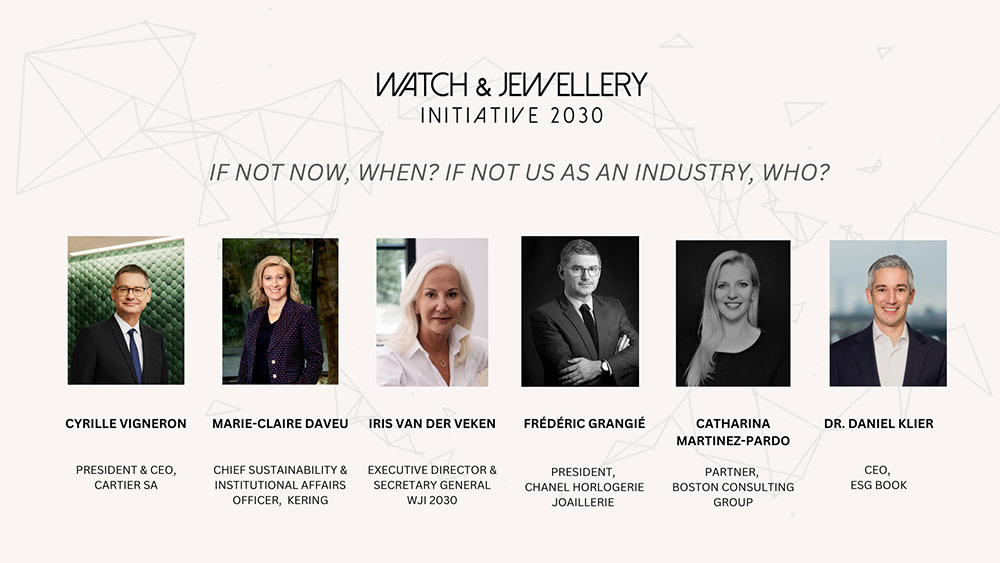
A C-level panel took place to commemorate 1 year since the establishment of the Initiative. The panel titled If not now, when? If not us as an industry, who? was moderated by Iris Van der Veken, Executive Director & Secretary General, of the WJI 2030.
The following C-level panelists joined:
- Marie-Claire Daveu, Chief Sustainability and Institutional Affairs Officer, Kering – WJI 2030 Co- founder
- Cyrille Vigneron, President & CEO, Cartier SA – WJI 2030 Co-founder
- Frédéric Grangié, President, Chanel Watches & Jewellery – WJI 2030 Member
- Daniel Klier, CEO, ESG Book – WJI 2030 Partner
- Catharina Martinez Pardo, Partner, BCG – WJI 2030 Partner
The panel discussed the urgency of accelerating the sustainability agenda in an ever-evolving regulatory and consumer landscape. Different drivers are accelerating transparency. The consumer is looking for trust and purpose, they want a company to demonstrate positive impact. Talent wants to work for a company that embraces true values and inclusion. As ESG regulations continue to evolve rapidly across multiple jurisdictions, corporations are navigating ever-more complex challenges around reporting.
Marie-Claire Daveu, Chief Sustainability and Institutional Affairs Officer at Kering shares “The WJI 2030 has accomplished several first achievements over the past year, and demonstrates how much we strongly believe in two key streams of action: partnership and multi-stakeholder consultation. Sustainability should not be a competitive field. We must work together if we want to transform the industry and make a true difference.”
Cyrille Vigneron, President & CEO, Cartier SA, further adds, “If you have good will, join us, and if you have good ideas, do and share, and they will benefit all.”
Frédéric Grangié, the President of Chanel Watches & Jewellery, highlights that “For several years now, Chanel Watches & Fine Jewelry has had the ambition that its activities be ever more responsible, its sourcing ever more traceable, and benefit local stakeholders and ecosystems. We always believed that this task would require a strong collective and sectoral involvement, and we didn’t find any new initiative that seemed comprehensive and consistent with our own commitments before the Watch & Jewellery Initiative. The Initiative meets our ambitions to ensure that the sector has a positive impact on the planet and on people.”
Daniel Klier, CEO of ESG Book emphasizes that “Sustainability reporting has passed the point of ‘no return’ – driven by investors, consumers, employees and regulators. As such, regulators around the world have defined more than 3,000 different ESG standards and policy revisions. The watch and jewellery industry has a unique opportunity to take a leadership role – driven by ambitious leaders and powerful brands.”
Followed by Catharina Martinez Pardo, Partner at Boston Consulting Group, Catharina shares that “In climate there is still a small window to act – to succeed, it is instrumental to get the commitment of executives, to support brands in accelerating their actions as well as leveraging the collective power to unlock large scale impact and provide a platform to find collaborative solution to the challenging and controversial topics.”
Finally, in closing the high-level panel, Iris Van der Veken, Executive Director & Secretary General of the Watch & Jewellery Initiative 2030 acknowledges that “I think we all know there’s no planet B. We only have one Mother Earth, so we have a duty to care. And as we work and live in an industry of so much beauty and art, I always say we need to double care. I think we also agree that only together we can do it. We need measurable results. The time is now.”
The recent IPCC report is a signal of how critical it is to accelerate action. An update was given on the progress made till date. Today the WJI 2030 has 35 members and is fast advancing towards launching collaborative action projects around its three strategic pillars: building climate resilience, preserving resources and fostering inclusiveness.
WJI 2030 has just launched its first stakeholder report. Stakeholder feedback has already informed aspects of WJI 2030 governance such as the multi-stakeholder/NGO representation with voting rights on the Board, the necessity of an independent and external risk and compliance committee, the strong focus on establishing a rigorous ESG data framework, and the importance of working closely with suppliers on the ground. An external B Corp-certified legal counsel was appointed in October 2022 to ensure best practice in governance.
WJI 2030 is built on a collaborative model. Our partnerships with United Nations Global Compact on the Solutions Lab, UN Women on WEPs implementation, ESG Book on transparency reporting, and learning from other industries, such as our alignment with the Global Fashion Agenda, demonstrates our vision of an initiative that builds strength through the positive power of the collective.
Over the last six months, WJI 2030 has conducted an extensive multi-stakeholder consultation – specifically on our strategy, approach and governance – with various key industry stakeholders, including our members, partners, associations, experts, and the wider industry.
Collaborative leadership is key as no single organisation or sector has all the knowledge and resources that are needed to make real progress.
Multi-stakeholder consultation is a fundamental part of the WJI 2030, and we aim to embed this approach into all that we do. Over 80 organisations took part in this consultation that has surfaced clear priority issues with respect to governance, leadership, strategy and operations. We will continue the consultation in the coming months.
We would like to take this opportunity to thank all of those who have dedicated time to this consultation and provided their feedback and support.
In light of this, WJI 2030 is pleased to announce the release of the Stakeholder Report 2023, providing an update on the Initiative, key findings from the consultations, and an overview of the governance framework and priorities.
Get the Report:
16 March 2023 – Global Fashion Agenda (GFA) and the Watch & Jewellery Initiative 2030 (WJI 2030) have forged a new alliance, to unite iconic fashion, watch and jewellery brands in a bid to accelerate positive impact. Through the partnership, industry leaders will collaborate to tackle shared social and environmental challenges.
The alliance between the two organisations will be initiated at the Global Fashion Summit: Copenhagen Edition 2023, taking place on 27-28 June. Presented by GFA, Global Fashion Summit is widely renowned as the leading international forum for sustainability in fashion.
The theme of the forum is ‘Ambition to Action’ – presenting content experiences, case studies and strategic roundtable meetings focused on tangible impact. The Watch & Jewellery Initiative 2030 will focus on strategic topics including climate, biodiversity and gender equality.
Beyond the Summit in Copenhagen, the organisations will provide platforms to convene fashion, watch and jewellery executives around the world to stimulate pre-competitive knowledge exchange, stringent commitments and impactful programmes.
Read the full press release here
The Watch and Jewellery Initiative 2030 was officially established in Geneva, on April 1st 2022 at the last edition of Watches and Wonders Geneva. WJI 2030 hosted a panel which commemorated the official establishment of the association, and therefore, it is fitting that we take this opportunity, one year later, at Watches & Wonders 2023 to commemorate 1 year of the association.
This year, at Watches & Wonders, WJI 2030 is delighted to host a high-level 30 minute panel, on the opening day of Watches & Wonders. Watches & Wonders will welcome nearly 50 brands, with most of the main players of the industry gathered to present their novelties during a week of wonders.
If you are at Watches & Wonders, please join us:
Monday 27th of March,
15:45-16:15 CET
If not now, when? If not us as an industry, who?
This CEO Panel is about shaping the sustainability agenda in an ever evolving regulatory and consumer landscape. Different drivers are accelerating transparency. The consumer is looking for trust and purpose, they want a company to demonstrate positive impact. Talent wants to work for a company that embraces true values and inclusion. How can one navigate itself in this ecosystem?
OUR PANELISTS:
In honour of International Women’s Day, Jaeger-LeCoultre announces their commitment to the WEPs and becomes a signatory.
Jaeger-LeCoultre CEO, Catherine Rénier, expresses their commitment to creating a positive culture that provides equal opportunity and fair treatment for all, building a legacy for future generations.
Dear friends and supporters of WJI 2030,
Happy International Women’s Day.
On International Women’s Day, we celebrate women and girls everywhere.
The Gender Snapshot Report 2022 , launched by UN Women and the UN Department of Economic and Social Affairs (UNDESA), highlights that at the current pace of progress, SDG 5—achieving gender equality—will not be met by 2030. Despite progress in reforming laws, closing gaps in legal protections and removing discriminatory laws could take up to 286 years based on the current rate of change.
Global challenges, such as the COVID-19 pandemic and its aftermath, violent conflict, climate change, and the backlash against women’s sexual and reproductive health and rights are further exacerbating gender disparities. Women’s representation in positions of power and decision-making remains below parity.
Nearly half way to the 2030 endpoint for the SDGs, the time to act and invest in women and girls is now. The case for supporting women’s empowerment is particularly strong in the jewellery industry. Women drive demand for a vast majority of the world’s jewellery. Furthermore, in the rapidly growing consumer movement, Millennial and now Gen Z women and girls are driving consumer decisions toward products and companies that act consciously and protect their supply chains.
The WJI 2030 is committed to accelerate SDG 5. The climate crisis is not “gender neutral”. Women and girls experience the greatest impacts of climate change, which amplifies existing gender inequalities and poses unique threats to their livelihoods, health, and safety. Across the world women depend more on, yet have less access to, natural resources. Implementing our 3 pillars on climate action, biodiversity, and inclusiveness is essential to the rights of women and girls.
We are proud of our partnership with UN Women on accelerating the Women’s Empowerment Principles Framework and piloting their gender responsive procurement tool with Monica Vinader, Swarovski, Gucci, Italpreziosi, Rosy Blue, Dimexon, Cartier, Rubel & Menasché, and Julie Sandlau.
We are calling on our industry leaders and stakeholders to join forces and accelerate efforts to make gender equality a reality for all. We hope you will enjoy the gender perspective from Susan Jacques (CEO and President, GIA), Cristina Villegas (Director Sustainable Markets PACT), Stefanie Cohen (Head of Sustainability, Swarovski), Eva von Alvensleben (Executive Director and Secretary General, The Fashion Pact).
We thank UN Women for their valuable input to WJI 2030 in sharing practical tools to help companies operationalize the gender agenda. We know that the origins of these challenges are structural and centuries old. Therefore, we need approaches and solutions that are systemic to achieve comprehensive and long-term results, leading to both structural, and cultural transformations.
This is our call for action, join the WEPs.
Marie-Claire Daveu,
Chief Sustainability Officer and Head of International Institutional Affairs of Kering
Cyrille Vigneron,
President & CEO Cartier International
Iris Van der Veken,
Executive Director & Secretary General Watch & Jewellery Initiative 2030
Interview with Cristina Villegas, Director Sustainable Markets, Pact
In many countries, women comprise 40 – 50% of the artisanal and small-scale mining (ASM) workforce, how can ASM create economic empowerment opportunities for women?
Most brands and consumers have no idea that about 90% of all mine labor worldwide is done by artisanal and small-scale miners, who are people using shovels, picks, and human strength to pull minerals from the earth. There are about 45 million ASM at work worldwide. Usually about one-third of a given country’s ASM workers are women, and sometimes it’s up to half. In terms of potential SDG impacts, working with ASM and working with women miners in particular can be a very powerful story of positive change. It’s common to find that women miners are the head of their household and that one miner’s income is supporting 5-7 children.
What are some of the challenges and how can they be tackled?
The challenges vary dramatically based on where the miner is located. With women miners, we tend to see them overlooked in training opportunities or in new government programs because people wrongly assume that women do not mine. So it can be a vicious cycle, where women already have the fewest resources, are overlooked in training opportunities, and are completely invisible to the jewelry industry. I’ve realized that if you do not start with women miners, they can become an afterthought. So the last few collaborations that I have led, I’ve started with women miners — with intention—so that the program ultimately reaches 50-50 gender parity. It takes more effort, but it’s been so worth it. Whole communities are changing before my eyes.
Can you share an example of a project that has delivered meaningful impact for women on the ground?
Over the past few years, Pact has worked with GIA, The Tiffany & Co. Foundation, The Brilliant Earth Foundation, The World Bank, and small, reform-minded studio jewelers to bring new opportunities to the hidden female workforce behind gem mining. These are programs such as gemology education and market skills trainings to help women miners understand their materials and command better prices using that new, expertly-taught knowledge. We also bring financial literacy and community-banking programs to gem mining communities to catalyze small businesses and income diversification. In Tanzania, we’ve been seeing women jointly start side-businesses focused on beekeeping, sisal farming, and chicken keeping. These activities help buffer communities against economic shocks and they stabilize household economics to help whole families. I remember that in one community, we learned that gem miners were skipping meals because they were so destitute. Our programs quickly turned that around. Those miners are now thriving.
How can the private sector support the empowerment of ASM communities?
ASM communities are filled with partnership opportunities for meaningful, lasting change. However, it is important to choose the right partner for this work. Pact, the Alliance for Responsible Mining, and Gem Legacy are all good choices. There are three ways that companies can responsibly ‘plug in’ to this work.
- Buy the Good Stuff! Start intentionally sourcing from responsible ASM sources. Think about special collections that you can make. Start small and scale it over time when these sources prove that they are consistent suppliers to you. In gold, your current choices are Fairmined, Fairtrade, Swiss Better Gold, and Just Gold. Pact is working on additional responsible gold sources that we hope will be available soon. In colored gemstones, there is the Moyo Gems program (which I run), and Virtu Gems. Both source high-end gemstones directly from ASM miners. In Moyo Gems, I’m particularly proud that 60% of the miners that we work with in Kenya and Tanzania are women miners. Imagine all of the storytelling opportunities! In diamonds, your current choices are GemFair and RootDiamonds, which are both sourcing diamonds from Sierra Leonean miners.
- Channel your philanthropic investments back into mining communities. Because of traceability breakthroughs that I’ve been a part of, you can now align your company’s corporate social responsibility funds to your source communities. For example, Moyo Gems offers this. There are ongoing greening supply chain initiatives, economic empowerment projects, and market initiatives that companies of any size can plug into. Just contact me!
- Engage, don’t disengage. One trend that I’m increasingly concerned about is companies intentionally disengaging from ASM sources on ‘sustainability’ grounds. This is particularly frustrating because artisanal miners – such as those who I work with in East Africa — are often the ones most affected by climate change. The biggest group of miners that I see in Tanzania are former farmers who have turned to mining because the changing climate has made the rains less frequent. In this case, disengagement from this source means taking away the only competitive livelihood that is now available to them. Careful engagement via trusted partners – where miners are assisted in greening supply chains– is the best response for meaningful, just sustainability practice. In the future, I foresee some artisanal sites being not only net zero, but climate restorative. Wouldn’t that be an interesting local and global legacy?